Tablet is a solid unit dosageform containing one or more active pharmaceutical ingredients (APIs), with or without excipients, prepared by or other suitable manufacturing processes.
In simple words, a tablet is a solid medicine prepared in a definite dose, usually by compressing powder or granules into a specific shape.
Examples: Paracetamol tablet, Metformin tablet, and Aspirin tablet.
Types of Tablets
Tablets can be classified according to their route of administration, method of preparation, and drug-release characteristics.
|
Type |
Description |
Example |
|---|---|---|
|
Compressed tablet |
Prepared mainly by compression |
Paracetamol tablet |
|
Multiple-compressed tablet |
Prepared by two or more compression steps |
Layered tablet |
|
Film-coated tablet |
Covered with a thin polymer film |
Film-coated Diclofenac tablet |
|
Sugar-coated tablet |
Covered with layers of sugar |
Sugar-coated tablets |
|
Enteric-coated tablet |
Resists stomach fluid and releases the drug in the intestine |
Enteric-coated Aspirin |
|
Chewable tablet |
Chewed before swallowing |
Calcium chewable tablet |
|
Effervescent tablet |
Releases gas when dissolved in water |
Effervescent Vitamin C |
|
Dispersible tablet |
Disperses in water before administration |
Dispersible medicine tablets |
|
Sublingual tablet |
Placed under the tongue for absorption |
Nitroglycerin tablet |
|
Buccal tablet |
Placed between the gum and cheek |
Certain buccal medicines |
|
Orally disintegrating tablet (ODT) |
Disintegrates rapidly in the mouth |
Some antihistamine tablets |
|
Sustained/extended-release tablet |
Releases the drug over a prolonged period |
Extended-release Metformin |
Important: Enteric-coated tablets should generally not be crushed or chewed because this may damage the protective coating. Modified-release tablets also require product-specific instructions.
Ideal Properties of a Tablet
An ideal tablet should have the following properties:
-
It should contain the correct amount of drug.
-
It should have uniform weight and drug content.
-
It should have sufficient mechanical strength.
-
It should not break or chip easily during handling.
-
It should disintegrate and release the drug as intended.
-
It should remain stable during storage.
-
It should have an acceptable appearance, size, shape, and taste where relevant.
-
It should be free from contamination and manufacturing defects.
-
It should be easy to package, transport, and administer.
Ingredients of a Tablet (Excipients)
Excipients are substances added to a tablet formulation other than the active pharmaceutical ingredient. They help in manufacturing, stability, appearance, and drug release.
|
Excipient |
Function |
Examples |
|---|---|---|
|
Active pharmaceutical ingredient (API) |
Produces the therapeutic effect |
Paracetamol |
|
Diluent/Filler |
Increases tablet bulk |
Lactose, microcrystalline cellulose (MCC) |
|
Binder |
Helps powder particles stick together |
Povidone (PVP), starch paste |
|
Disintegrant |
Helps the tablet break apart after administration |
Croscarmellose sodium, sodium starch glycolate |
|
Lubricant |
Reduces friction during compression and ejection |
Magnesium stearate |
|
Glidant |
Improves powder flow |
Colloidal silicon dioxide |
|
Antiadherent |
Prevents sticking to punches and dies |
Talc |
|
Colouring agent |
Provides colour and identification |
Approved colouring agents |
|
Flavouring agent |
Improves taste |
Suitable flavours |
|
Sweetening agent |
Improves sweetness |
Aspartame, sucralose |
|
Coating agent |
Protects the tablet or modifies appearance or release |
Suitable film-forming polymers |
Remember the difference:
-
Binder: Holds particles together.
-
Disintegrant: Helps the tablet break apart.
-
Lubricant: Reduces friction.
-
Glidant: Improves powder flow.
-
Diluent: Adds bulk.
Methods of Tablet Manufacturing
The main methods are:
1. Wet Granulation
Powder ingredients are mixed, a suitable granulating liquid is added, and granules are formed. The granules are dried, sized, lubricated, and compressed.
Suitable when the formulation benefits from granule formation and the ingredients tolerate the process conditions.
2. Dry Granulation
Powder ingredients are compacted without using a granulating liquid. The compacted material is milled into granules, lubricated, and compressed into tablets.
Useful for materials that are sensitive to moisture or heat associated with wet granulation.
3. Direct Compression
Suitable API and excipients are blended and compressed directly into tablets without a separate granulation step.
It requires suitable powder flow and compressibility.
Comparison of Manufacturing Methods
|
Feature |
Wet granulation |
Dry granulation |
Direct compression |
|---|---|---|---|
|
Granulating liquid |
Used |
Not used |
Not used |
|
Separate drying step |
Usually required |
Not required |
Not required |
|
Number of processing steps |
More |
Moderate |
Fewer |
|
Main consideration |
Moisture and drying |
Compaction properties |
Flow and compressibility |
|
Process complexity |
Relatively high |
Moderate |
Relatively low |
6. Steps of Tablet Manufacturing
A. Wet Granulation Method
The general manufacturing sequence is:
1. Dispensing / Weighing
2. Sifting
3. Dry mixing
4. Preparation and addition of binder solution
5. Wet massing / Granulation
6. Drying
7. Sizing of granules
8. Lubrication / Final blending
9. Tablet compression
10. Coating (if required)
11. Inspection and quality control
12. Packaging
Explanation of Important Steps
-
Dispensing: Raw materials are weighed according to the approved batch manufacturing record.
-
Sifting: Materials are passed through a suitable sieve to remove lumps and obtain a suitable particle size.
-
Dry mixing: The API and selected excipients are mixed uniformly.
-
Binder addition: A binder solution or suitable binder system is added.
-
Granulation: Powder particles are converted into granules.
-
Drying: Excess moisture is removed to the specified limit.
-
Sizing: Dried granules are passed through a suitable screen to obtain a suitable size distribution.
-
Lubrication: Lubricant and other final-blend ingredients are mixed with the granules.
-
Compression: Granules are compressed into tablets using a tablet compression machine.
-
Coating: A coating is applied if required by the formulation.
-
Inspection and quality control: Tablets are checked for appearance and applicable quality specifications.
-
Packaging: Approved tablets are packed in suitable containers or blister packs.
Note: Actual processing steps and in-process controls depend on the approved formulation and manufacturing procedure. Direct compression and dry granulation follow different process sequences.
7. Tablet Compression Machine
A tablet compression machine converts powder or granules into tablets by applying compression force.

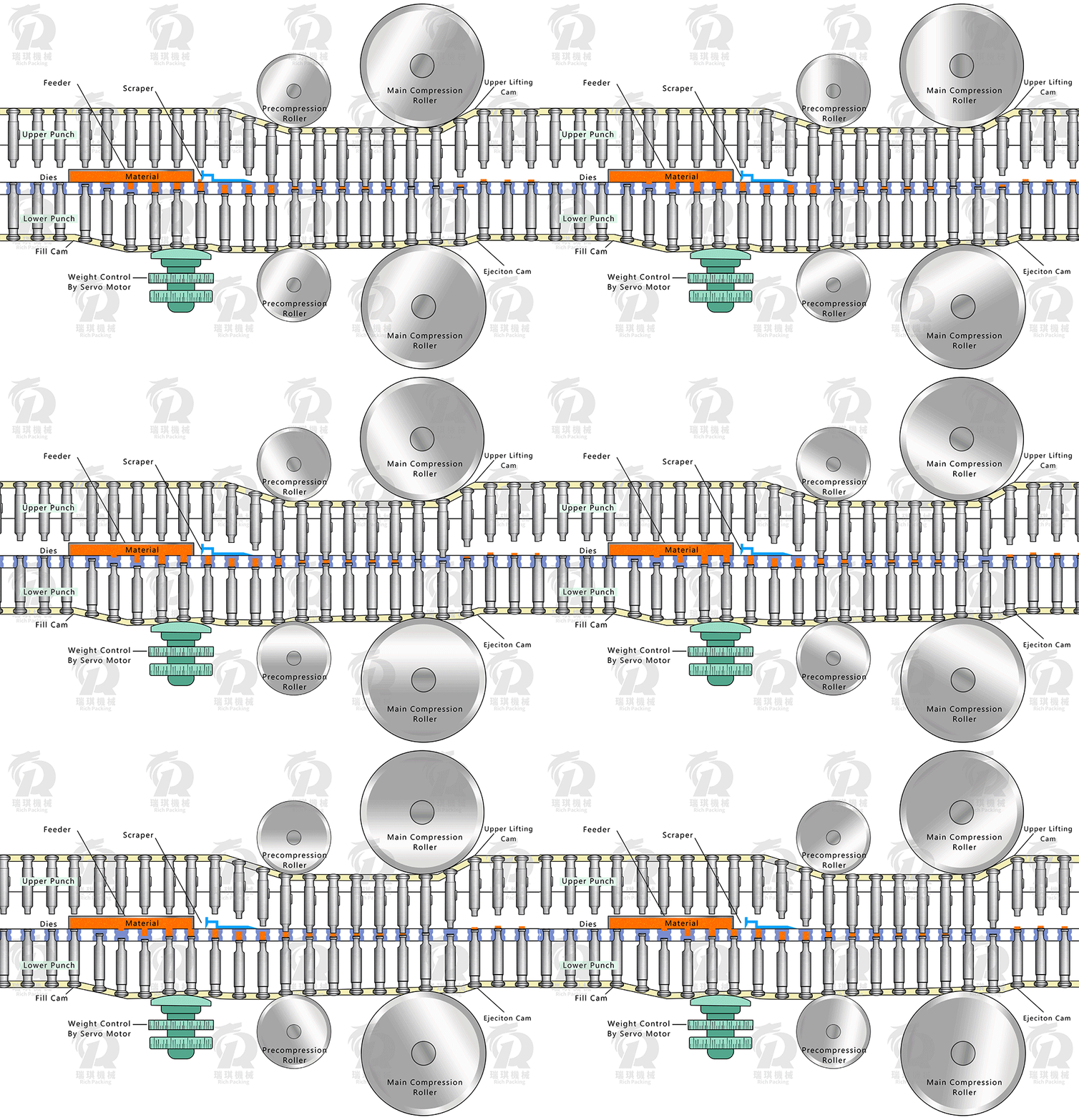
Main Parts and Their Functions
|
Part |
Function |
|---|---|
|
Hopper |
Holds the powder or granules |
|
Feed frame |
Distributes material into the dies |
|
Die |
Determines the tablet's diameter and shape |
|
Upper punch |
Applies compression from above |
|
Lower punch |
Supports the material and helps control filling and tablet ejection |
|
Turret |
Holds and rotates the punch-and-die stations in a rotary press |
|
Compression rollers |
Apply the force needed to form tablets |
|
Ejection system |
Helps remove the compressed tablet from the die |
Types of Tablet Compression Machines
-
Single-punch machine: Uses one punch-and-die station at a time; suitable for laboratory work and small-scale production.
-
Rotary tablet press: Uses multiple punch-and-die stations on a rotating turret; suitable for high-volume production.
8. Quality Control Tests for Tablets
Tablet quality control ensures that tablets meet the required specifications for identity, strength, purity, performance, and consistency.

1. Weight Variation / Uniformity of Mass
Checks whether individual tablet masses comply with the applicable pharmacopoeial requirements. It helps assess consistency of tablet mass.

2. Hardness / Crushing Strength
Measures the force required to break a tablet under specified test conditions. Tablets need adequate strength for handling and transport.

3. Friability Test
Evaluates the tendency of tablets to lose mass through abrasion or mechanical stress. A commonly used pharmacopoeial reference limit for many conventional uncoated tablets is not more than 1.0% mass loss, where applicable.

4. Disintegration Test
Determines whether tablets break down into particles under specified test conditions within the required time.

5. Dissolution Test
Measures the rate and extent to which the drug dissolves in a specified medium under defined conditions.

6. Assay
Determines the amount or concentration of the API in the tablet sample.
Other Important Tests
-
Uniformity of dosage units: Evaluates whether individual dosage units contain an appropriate amount of the drug. Depending on the monograph, this may involve content uniformity or an applicable mass-variation procedure.
-
Appearance: Checks colour, shape, surface, markings, coating, and visible defects.
-
Dimensions: Checks tablet thickness and diameter, where specified.
-
Moisture content: Measures moisture when required by the formulation or specification.
-
Identification test: Confirms the identity of the API.
-
Impurity testing: Evaluates specified impurities and degradation products.
-
Microbial quality: Tested where required for the product.
Important for QA/QC interviews: Not every test is mandatory for every tablet. The applicable pharmacopoeia, approved product specification, and regulatory requirements determine which tests and acceptance limits apply.
9. Common Tablet Defects
|
Defect |
Meaning |
Possible causes |
|---|---|---|
|
Capping |
Separation of the upper or lower part of a tablet |
Air entrapment, poor formulation, unsuitable compression conditions |
|
Lamination |
Tablet separates into two or more layers |
Air entrapment, formulation or compression problems |
|
Sticking |
Material adheres to the punch face |
Excess moisture, sticky formulation, inadequate lubrication |
|
Picking |
Material sticks to a small area of the punch face, often around a logo |
Local sticking, unsuitable moisture level, punch-face problems |
|
Mottling |
Uneven colour distribution |
Poor colour distribution, ingredient migration |
|
Chipping |
Breaking of tablet edges |
Insufficient strength, handling or tooling problems |
|
Cracking |
Cracks develop on the tablet surface |
Formulation, drying, or compression problems |
|
Weight variation |
Individual tablets have inconsistent mass |
Poor flow, inconsistent die filling, machine-setting problems |
|
Hardness variation |
Tablet crushing strength varies |
Variation in fill, granules, or compression conditions |
|
Double impression |
Duplicate marking appears on the tablet |
Punch movement or tooling design issues |
QA principle: When a defect occurs, the batch should be assessed according to approved procedures. The cause should be investigated, documented, and addressed through the appropriate quality system, including CAPA when warranted. Do not simply adjust machine settings without following authorized procedures.
10. In-Process Quality Control (IPQC)
IPQC means In-Process Quality Control. It involves checks performed during manufacturing to ensure that the process remains under control.
Typical tablet-manufacturing checks include:
-
Blend or granule appearance and relevant process parameters.
-
Granule moisture content, where applicable.
-
Tablet weight or mass.
-
Tablet thickness and diameter.
-
Tablet hardness or crushing strength.
-
Friability, where required.
-
Disintegration, where required.
-
Appearance and identification markings.
-
Compression-machine parameters and documented adjustments.
The sampling frequency and acceptance limits must follow the approved batch documentation and applicable procedures.
11. Advantages of Tablets
-
Accurate and convenient unit dosing.
-
Generally easy to handle, transport, and store.
-
Good stability for many formulations.
-
Suitable for large-scale, economical production.
-
Can be manufactured in different shapes, sizes, and release profiles.
-
Packaging and labelling are convenient.
-
Can mask unpleasant taste using suitable coatings or other formulation techniques.
BP
12. Disadvantages of Tablets
-
Some patients have difficulty swallowing them.
-
Not all APIs can be formulated easily as tablets.
-
Drug release can be affected by formulation and manufacturing variables.
-
Some tablets may be unsuitable for patients who require rapid administration or cannot swallow solid dosage forms.
-
Certain tablets are sensitive to moisture, heat, or light.
-
Modified-release and enteric-coated products may be damaged if crushed or split inappropriately.
13. Important Differences for Exams and Interviews
Disintegration vs Dissolution
|
Disintegration |
Dissolution |
|---|---|
|
Tablet breaks down into smaller particles. |
Drug molecules go into solution in the test medium. |
|
Evaluates physical breakdown. |
Evaluates drug-release performance under specified conditions. |
|
Does not directly measure the amount of drug dissolved. |
Measures the amount or percentage of drug dissolved over time. |
A tablet may disintegrate but still fail to meet its dissolution requirement.
Hardness vs Friability
|
Hardness |
Friability |
|---|---|
|
Measures resistance to crushing under a defined test. |
Measures resistance to abrasion and mechanical stress. |
|
Usually expressed as force. |
Usually expressed as percentage mass loss. |
|
Helps assess mechanical strength. |
Helps assess resistance to chipping and abrasion. |
Binder vs Disintegrant
|
Binder |
Disintegrant |
|---|---|
|
Promotes cohesion between particles. |
Promotes tablet breakup after administration. |
|
Helps granules or tablets maintain their structure. |
Helps expose the drug for subsequent dissolution. |